
Welcome to Drone Programming & Autonomous Robotics (11+)
Drone Programming & Autonomous Robotics is an advanced aerospace engineering, computer vision, and autonomous flight program created by MyCodingClasses.com for students aged 11 and up. Combining programmable indoor quadcopters with cutting-edge text coding, this course takes students beyond manual joystick piloting into the high-tech world of autonomous drone aviation.
Instead of just flying drones manually, students write real Python and block-based algorithms to command autonomous takeoffs, 3D spatial navigation, obstacle avoidance, and aerial missions. By interfacing software code directly with real-world flight hardware, every student transforms raw code into precise aerial maneuvers.
STEM & Aviation Skills Your Child Builds With Drone Robotics
1. Aerodynamics & Flight Physics
Students master the physical and aerodynamic principles governing multirotor aircraft:
- Understanding lift, drag, thrust, gravity, and pitch/roll/yaw flight dynamics
- Balancing motor RPMs, battery telemetry, and payload distribution for stable hover
- Analyzing environmental variables like air currents, room dimensions, and surface friction
2. 3D Spatial Geometry & Flight Trajectories
Autonomous flight grounds mathematics in 3D physical space:
- Programming flight paths using x,y,z Cartesian coordinate offsets and vector angles
- Calculating flight speeds, deceleration curves, and rotational degrees for precise waypoints
- Translating geometric equations into smooth, multi-dimensional aerial maneuvers
3. Sensor Integration & Computer Vision
Drones learn to perceive and react to their environment in real time:
- Utilizing optical flow sensors, barometric pressure gauges, and time-of-flight (ToF) rangefinders for altitude holding
- Programming onboard cameras to recognize visual targets, Aruco markers, and color patterns
- Implementing obstacle detection logic to trigger automated mid-air holds and course corrections
4. Text-Based Python & Algorithmic Scripting
Students transition into real-world software engineering workflows:
- Writing structured Python scripts using specialized drone APIs and SDKs
- Utilizing conditional logic (
if/else),for/whileloops, and custom functions to automate mission profiles - Managing telemetry streams, battery status checks, and flight state loops
5. Flight Safety, Protocols & Systems Debugging
When a drone strays off course or a mission fails, students practice professional aviation workflows:
- Establishing safety perimeters, emergency land triggers, and pre-flight checklist protocols
- Reading terminal error outputs and sensor logs to diagnose code logic bugs versus hardware drift
- Calibrating onboard gyroscopic sensors and IMUs (Inertial Measurement Units) for steady flight
6. Autonomous Mission Planning & Teamwork
Students collaborate in real-world aerospace team structures:
- Working in specialized team roles: Flight Director, Systems Programmer, and Safety Officer
- Mapping out multi-stage search-and-rescue, delivery, or obstacle-course mission logs
- Presenting flight code and live mission demos to peers and instructors
Why Drone Programming Is Perfect for STEM Learning
- High-Impact Real-World Tech — Connects software development directly to the fast-growing industries of commercial drones, logistics, and aerospace.
- Pure Physical Feedback — Code errors are immediately visible in 3D air space, reinforcing precise logic and careful debugging.
- Smooth Bridge to Python — Uses intuitive flight commands to make text-based Python syntax engaging and highly rewarding.
- Safety-First Sandbox — All flight sessions utilize lightweight, safe, indoor quadcopters within controlled flight zones.
- STEM & NGSS Aligned — Aligns with national standards for physics, computational thinking, engineering design, and 3D spatial geometry.
Powered by MyCodingClasses.com
Our specialized instructors guide students through flight dynamics, Python scripting, and mission safety in a structured, high-energy environment.
Students receive:
- Guided, step-by-step instruction in flight mechanics, sensor integration, and Python programming
- Access to programmable indoor quadcopters, sensors, and safety gear on-site
- Individualized support to debug flight code and calibrate drone sensors
- A collaborative arena setting where student teams execute live autonomous flight missions together
Autonomous Drones + MyCodingClasses.com = turning a curiosity for aviation into real aerospace software engineering.
Ready to Give Your Child a STEM Advantage?
Learn How Drone Programming & Autonomous Robotics Builds STEM Skills
The Capstone Project: The Autonomous Flight Challenge
By the final session, student teams program, calibrate, and execute a custom Autonomous Aerial Mission:
- Programmed Flight Routine: A fully automated flight script executing multi-point waypoint navigation, 360∘ spins, and aerial flips
- Sensor-Driven Obstacle Avoidance: Autonomous code utilizing optical or camera sensors to navigate through ring gates and land on target pads
- Search-and-Rescue Scenario: A simulated mission where the drone autonomously scans an area, identifies a visual target, and returns to base
- Live Flight Showcase: A live flight demonstration presenting code architecture and mission results to family and friends
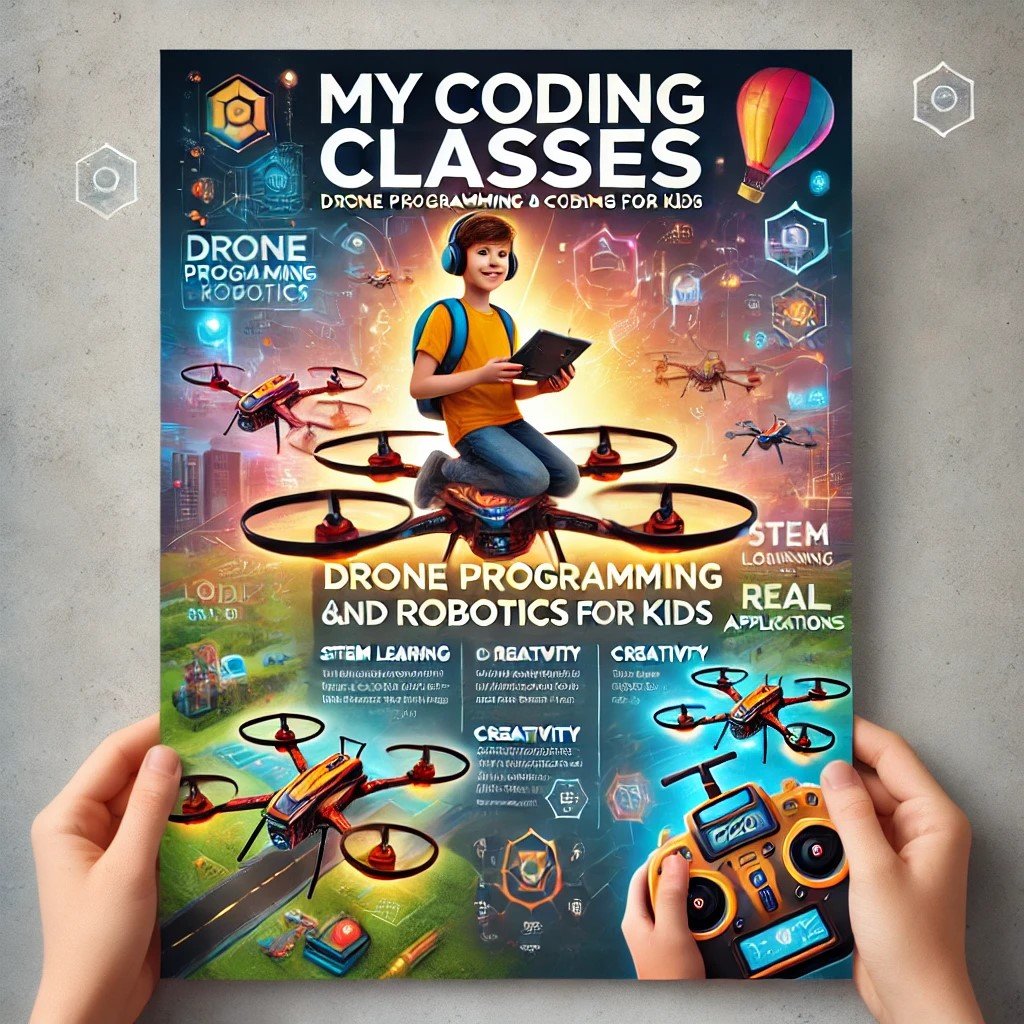
A STEM Landing Page Built for Parents, Students & Educators